Is research and theory relevant in the media profession?

This week’s discussion focuses on how mass communication theory can be applied to resolve challenges in the mass communication industry. First, let’s discuss the relevancy of mass communication theory as it pertains to today’s careers. Then, I’ll note a current challenge within the industry and how theory can be applied to solve it. When it comes to careers in the media profession, many students and professionals tend to pursue what I call spotlight roles, meaning popular or common positions in mainstream America such as a news journalist, public relations specialist, marketing advertiser, etc. Although these roles might involve some form of research and theory investigation, it’s probably not at the same level as individuals who spend their entire day doing this type of work as they have less engagement with the public (e.g. sitting in front of a camera, direct contact with customers and external stakeholders, etc.).

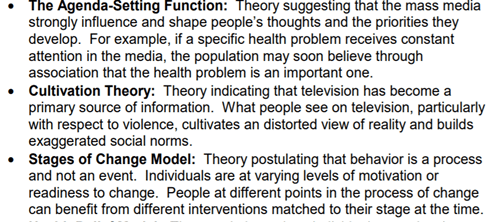
Roles involving research and theory are vital to the mass communication field and the reason for its existence today. It was important for scholars to form a hypothesis or theory, which led to creative developments and so forth. Below is a list of communication theories that are relevant and actively used today.  
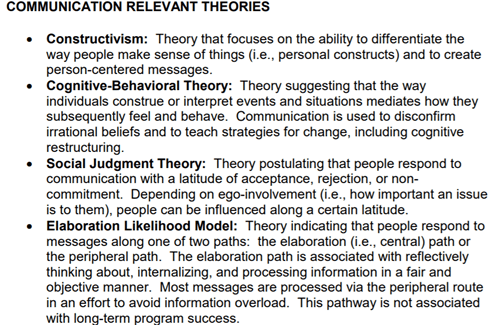
OakRidgeInstituteforScienceandEducation2020CommunicationRelevancyTheories

One of the challenges in the mass communication industry is media ethics. I believe we can all think of an example of when we question the ethics of an individual, network agency, or organization pertaining to a media-related issue. For example, there’s a recent news report regarding Dave Chappell’s concerns of Netflix publishing a show on their network without his approval. Chappelle understood the organization had a legal right to do so but called into question their ethics. He stated, “When I left that show I never got paid. They (ViacomCBS) didn’t have to pay me because I signed the contract. But is that right? I found out that these people were streaming my work and they never had to ask me or they never have to tell me. Perfectly legal ‘cause I signed the contract. But is that right? I didn’t think so either” Deadline.com2020chappellesshowremovednetflix

As Chappelle stated, the organization had a legal right to release his work, but was the right thing to do? This violation seems to happen a lot in the media, particularly on social media where so much information is published on a daily basis. It’s almost impossible to police what information is misappropriated on social media in real time. By the time the violation is discovered, It would have already reached the masses and possibly copy written and published by another viewer.

Bing.com2020MediaEthics

There is an area in mass communication that addresses this type of violation, media law and ethics. Chappelle raised the legal and ethical aspects of the matter that are two separate practices in mass communication but work alongside each other – media ethics vs media law. I won’t bore you with the details of the different meanings. It’s probably obvious in the Chappelle’s case there was no legal contract to say Viacom and Netflix couldn’t publish the show, which would fall under the media law category. The organizations agreeing to remove his show from Netflix addresses the media ethics of the issue.

As social-media use continue to grow with traditional media and streaming service networks vying for a piece of the market share, I can see this issue becoming more problematic. There’s an opportunity to assess mass communication roles that involve research and theory work, which addresses media law and ethics. For additional information on media law vs media ethics, check out the video below.

What does the future of the media looks like for me?

This past week my focus was to research a mass media journal and select an article that I find most beneficial to my future career. My future career is in the field of global communication. In short, global communication examines how information is exchanged across geographical and social divides and the influence it has on culture, politics, media, economies, and relationships. There are various roles within the global communication field such as public relations specialists, journalists, and market researchers. The professions in this area concentrate on developing and sharing messages that reach audiences across borders with a political focus whether it’s selling a product or addressing illegal labor practices. The key factor is to have a diverse-cultural approach in mind 2017mastersincommunications.com. As you can see, global communication is a broad field that largely focuses on how information flows through culture exchange and how culture, politics, economics, and society is impacted by it. An example of a global communication matter is: How does strategic communication practices through social media influences healthcare in African countries? Check out the short video clip on the global communication profession

Blanquerna.2018degreeinglobalcommunication

The article that I select is Introduction: Foundations of the Theory and Practice of Global Media Communication Policy. The authors summarized the need to develop a global media communication policy to set standards on how the media operates through transnational corporation from a political standpoint. With a myriad of technology devices that allow us to communicate across the globe, there’s no wonder we experience a great deal of challenge on understanding laws and regulations as well as politics in how we communicate with each other. In this profession whether you’re a public relations specialist or marketing advertiser, you must be aware of the culture, politics, and economic environment in the countries which your organization operates in. This means knowing the culture of a country in how they communicate and respecting their values and beliefs. In some foreign countries there are laws that prohibit the use of certain language, behavior, and how you communicate to the public. If you violate these laws, it could reap major damage for the organization as well as your career, and possibly leading to a criminal charges.

As a communication specialist, it’s important to work with your colleagues in foreign countries to understand these principles and learn how bridge them with countries that practice the opposite such as the United States. In America, freedom of speech is protected and publicized. How does one create and publish messages for a global organization with different target audiences, cultures, customs and values, etc.?  Additionally, when centralizing messaging, you must understand that content could be perceived and received in a different manner than what you expected. That is why it’s important to know your global cross-functional teams, which communication tools to use for the right target audience, and when to include and exclude information based on the audience’s culture.

In conclusion, this challenging field will keep you engaged and creating new ideas and invention. Learning about people who do not share your same culture and beliefs and knowing how to communicate with them is intriguing and fulfilling.

Dreamstime2020World Communication Network Stock Images

International Communication -what’s the difference?

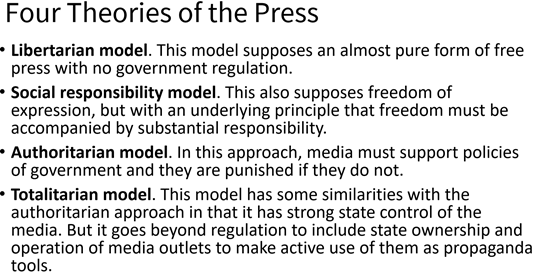
This week’s discussion focuses on international communication in how different nations have different political structures and policies as it pertains to media regulation. I selected to watch a broadcast from BBC Nightly News and ABC Nightly News to compare the differences between the two media outlets in terms of which topics covered, differences in local news, formatting, style, and delivery. Although the U.S. and European media systems are closely similar, differences are present. “European media systems operate more as social institutions while U.S. models are focused on media independence and a marketplace approach” RosenberryVickers2017TheoriesofInternationalCommunication. The Seminal Four Theories Model (e.g. Four Theories of the Press), explains the relationship of media, society, and politics around the world. Let’s see if we can identify which model BBC Nightly News and ABC Nightly News fall under.

EvansV2020Fourtheoriesofthepress

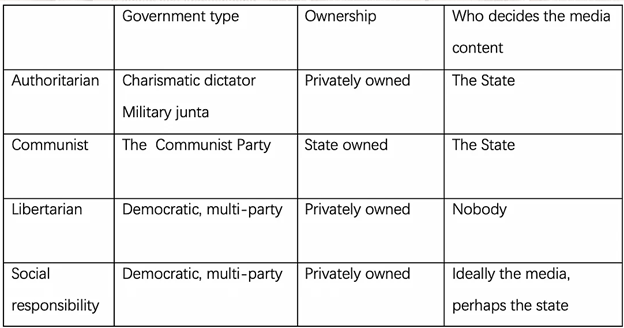
ABC Nightly News would apply to the libertarian model. The U.S. law protects the form of free press with no government relationship. BBC Nightly News would fall under the social responsibility model. “BBC, RTE and CBC are wholly or partially funded by their national governments and answerable to them. That means they have both financial incentives and government regulations and policies encouraging them to create programming “in the public interest” EvansV2020Fourtheoriesofthepress. Below is a chart with more information on the four models. It’s segmented by government type, ownership, and who decides the media content.

Wix.com2018Piece&HarmonyAnalysisofSingaporeandMalaysiaSystems

Now, let’s discuss the broadcasting differences that I witnessed between the two media outlets. The airing date for both broadcasting was on Nov. 3rd, the U.S. presidential election date. There’s no surprise the U.S. presidential race was at the top of the list, particularly for ABC Nightly News versus BBC Nightly News. BBC Nightly News published a shorter segment on the U.S. presidential race and topics such as the possibility of a cold war between China and the U.S., coronavirus lockdown in the U.K. and a terrorist attack in Vienna Austria. There were several presenters covering different topics in different background settings. Some journalists delivered their presentation standing with the stories displayed on screens and others sat with the same background setup.  

ABC Nightly News spent most their airtime monitoring election results with journalists stationed across the country capturing news coverage of the race. There was one main journalist tuning into reporters in the field vs BBC journalists assigning a main journalist for almost each topic. ABC News spent the duration of time on the race, which included counting mail-in ballots in battleground states, gatherings of social movements, short interview clips of political analysts giving their take on the elections results, etc. The remainder time spent was on the terrorist attack in Vienna Austria and Hurricane forecast in Central America.

Although there were slight differences in the format, style, and delivery of information from the two news outlets, it was evident they shared similarities in terms of the media systems and political power within society. According to the Marxist political economy theories, the dependency theory states that transnational corporations with support of their home governments (especially the United States and European powers) set the agenda for world economic development. In conclusion, these two global powerhouses share similar political ideologies and government structures with the exception that European media is funded by their government. They leverage this relationship to continue remaining in elite status and push their western ideologies to less developed countries.  

Is the Medium really the message? Let’s review!

Marshall McLuhan, a Canadian media scholar, theorized that forms of communication as it pertains to media technologies affect patterns of human thinking and human beings’ ways of relating to the world around them. In other words, McLuhan believed the communication channel that we use to communicate, the medium (e.g. TV, radio, phones, Internet, etc.), is more important than the message itself. Imagine face timing me, but I cannot understand what you’re saying. According to McLuhan, the fact that we were able to connect through face time is important than the message you’re trying to convey to me. Check out this short clip on McLuhan’s theory, the medium is the message.

BBCRadio42015TheMediumistheMessage

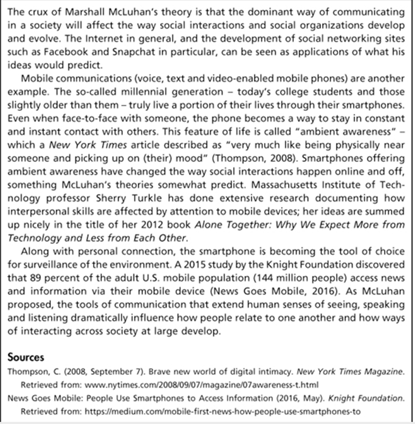
McLuhan’s focus was on how technological advancements united people together on a global level. He called it a ‘global village.’ He wanted us to understand the magnitude of how we evolved over time with technology. Come to think of it, he is correct. It’s truly amazing to see how we started from hieroglyphics to advanced technology. I will not discredit him for that. However, we cannot reduce the importance of the message itself as second in line.  According to McLuhan, a culture in which this is the dominant form of communicating is going to be relational and communal Rosenberry&Vicker2017McLuhan’sTechnologicalDeterminism. For additional detail on McLuhan’s theory as it relates to advance technology, see figure below.

Rosenberry&Vicker2017WhatwouldMcLuhansayaboutFacebookandSmartphones

There were several strong points as well as weak points in McLuhan’s theory. His strong points are technology has developed into a global village in how we are able to connect with others around the world. It has affected the way social interactions and social organizations evolved. Another strong point he made is that technology has made it possible to where we are able to complete tasks in an efficient and effective way (using tools rather than physical energy, computer with software/hardware that can perform editing capabilities vs a typewriter, connect with a person virtually without leaving your home, etc.). Lastly, he believed that communication in the electronic era uses multiple senses as oppose to print style, which is linear. An example is someone watching television can hear the telephone ring and continue watching the show even as they take the call to talk, whereas, with the linear-print paradigm, a person trying to read a book and newspaper at the same time will not work. They would have to be read sequentially (Rosenberry & Vickers, 2017).

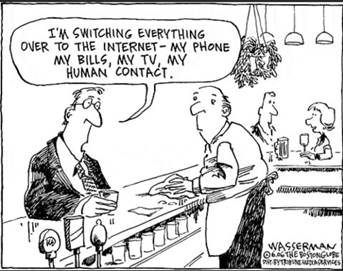
One of his weak points is believing forms of communication are more important than the message itself. I understand his rationale was to explain the effects of technology in how it’s able to connect people across the world. However, he limits this concept by understanding that no matter what form of technology a person uses, if the message is not clear, the device or form of communication is useless. Another weak point is undermining the power and value of face-to-face communication, which is just as effective today, if not more, as it was from the beginning of time. We have transitioned to a world of technological advancement replacing face-to-face communication with devices, which there’s a lot of misinterpretation, misunderstanding, and confusion. Technology has also replaced a personal, intimate form of communication. Families are selecting to have their meals in separate rooms while entertaining themselves with their electronic devices. Organizations are replacing onsite group meetings that can create great team dynamics where individuals feel comfortable expressing their ideas and opinions without countless distractions from equipment failure or attempting to multitask, not willing to give their undivided attention to the group.

Lastly, McLuhan believed it didn’t matter what an individual watched on television or who controlled the content, what matters is that an individual was watching television and not reading a magazine. His focus on technology failed to look beyond and see that something or someone (e.g. media) had the power to change social structure other than technology itself. I find McLuhan’s ideas useful in terms of how society has evolved through technology making it possible to communicate and accomplish tasks at a faster rate. We have progressed in those terms. However, I also find his ideas misleading, particularly on believing the ‘message’ is not more important than the form of communication.

Sociologytome2020SocialInteractionandSocialStructure

Agenda setting done the right way!

If success is to be achieve, agenda setting must be at the forefront of every newscast’s goal, especially in this new environment where citizen journalists are gaining momentum in the marketplace of attracting viewers. When thinking of the agenda setting process, keep in mind there are three components: priming, issue obtrusiveness, and framing. In framing, a journalist decides what information to include and what information to exclude from a report by framing a story or picture in the minds of the audience. This process involves careful selection of words, phrases, and images to use when writing a story. Priming involves the process by which the media ignores some issues and attend to others. This process affects the attention the public gives to the issue and how important it seems to the audience. Simply put, the media is not telling the audience how to think, but selecting which stories to publish nudges the audience to give attention to that story. Lastly, in issue obtrusiveness, the media selects which issue to bring before the public RosenberryVickers2017AgendaSettingTheoryProcess. For example, currently COVID-19 vaccination is a hot topic over climate change so it’s no surprise we are hearing and seeing more from the media on this topic. For more information on the agenda setting theory, check out this video below (2:20 minutes).

LambB2012The Agenda Setting Function Theory

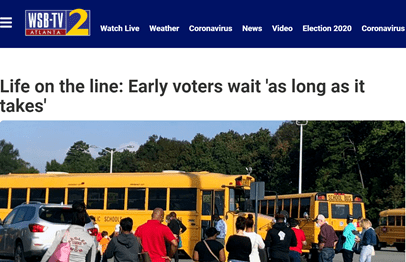
In viewing a story from a local newscast, WSBTV Channel 2, the agenda setting attributes are noticeable. The story is pertaining to the urgency of voting in that it will make a difference between life and death. Would it really have that much impact? The headline reads ‘Life on the line: Early voters wait as long as it takes.’

KellmanL2020Lifeontheline:Earlyvoterswaitaslongasittakes

In reading the article, I noticed the journalist framing the story before I finished it. The journalist described the long line with words and phrases for viewers to understand its intended message. One quote in the article states, “What I tell my kids is, there’s people that look like us that have died for this right,” said Manny Golfe, 44, a commercial banker who waited almost two hours to vote for Democrat Joe Biden” KellmanL2020Lifeontheline:Earlyvoterswaitaslongasittakes. In the next sentence, the journalist included another quote from a voter. It reads, “If you want the United States to remain united, you need to vote,” said Monique Sutton, 52 and a nurse practitioner. “Because if we get any further away from each other, I don’t know that we’ll ever be able to come back” KellmanL2020Lifeontheline:Earlyvoterswaitaslongasittakes.

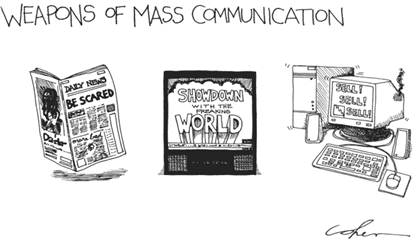
            These are only a few statements the journalist wrote in the article to paint a picture of comparing the urgency of voting to life and death, even if a person believes neither candidate represent their values and beliefs. In conclusion, a story can spin many ways based on the writer’s intention. The tools of mass communication such as agenda setting can be used to incite courage, hope, and compassion or fear, doubt, and chaos.

Bing.com2020PrimingTheoryofMassCommunication

How do you get your news and does it matter?

When examining how news spread through my social group, I have to assess the various sources (e.g. channels) in which we receive information. I’ve always believed in listening to or watching more than one news source so I can get a balance perspective of what’s being reported. Thereafter, I crosscheck the information for accuracy. This is the case even with mainstream media such as local news, CNN, Fox, MSNBC, etc. I do not select one over the other. However, I must say, lately I have limited watching these sources due to the current political environment and how the mass media has become so blatantly bias in their reporting. It’s not by accident that the media select what stories to cover over other stories. Actually, this process is known as priming.

Gemala2014CurrentResearchofMediaPriming

Priming in media means ignoring some issues and tending to others. “When the media prime an issue, such as an increase in the minimum wage, over another issue, such as veteran’s access to healthcare, it affects the attention the public gives to the issue and how important it seems to the audience” (Rosenberry&Vickers2017TheSociologicalPerspectiveonMassCommunicationTheory). This is the sole reason for my selecting various sources outside of mass media. You do not have to believe or support the news outlet in order listen to or watch them. I receive information from mainstream media and crosscheck with other outside sources.  What I admire about my non-mainstream media sources is that we’re able to have genuine conversations where we can express our personal opinions about a story. You cannot do this with mainstream media unless you take time to contact the organization and it’s not a guarantee that you will receive a response.

If I had to provide a breakdown of how I receive news from the mass media and non-mass media sources, I would say that I receive 70% of news from non-mass media sources via social media. The other 30% comes from mass media, which is also viewed online. I rarely watch/listen to news from the radio and television. What makes it easy to validate information from (mass media and non-mass media sources) is a quick google search. Within minutes, if not seconds, you’re able to verify the accuracy of a story being reported from either source. You need diverse sources even if it’s to get an understanding of how others beside yourself think about a situation. “Traditional media outlets were no longer the sole gatekeeper for what was deemed newsworthy. Indeed, citizen journalists have shifted the balance of power and have as a group impacted the public’s agenda. At the same time, she found that traditional media still had the strongest influence” Rosenberry&Vickers2017TheSociologicalPerspectiveonMassCommunicationTheory).

Check out the video below on citizen journalists vs mass media journalists. There are some great points made as to why these individuals prefer a diverse choice of news reporting.

Harper2014CitizenJournalismvsProfessionalJournalismWhoismorereliable?

Will there be a mandate on the coronavirus vaccine?

BBC News. (2020). Getty’s Image

The topic of discussion centers on distributing the coronavirus vaccination and what will happen to the already-divided country if it becomes a mandate for all citizens. I selected this topic because it’s controversial, realistic, and incite some level of anxiety, especially in individuals who do not believe in taking the vaccination. Many individuals are erring on the side of caution because the vaccination hasn’t been tried and tested long enough to roll out within the next month, which happens to be around election time. There are people who believe taking the vaccination violates their personal beliefs (religious and non-religious). Additionally, there are people who vehemently opposes the vaccination but choose to follow a holistic, healthy lifestyle that includes a healthy diet, exercising, and engaging in medicinal herbal remedies. Moreover, let’s not forget the people who won’t wear a mask in public. How do you approach them with the possibility of a mandate policy on COVID-19 vaccination?

I personally don’t feel comfortable neither confident for the need to rush this vaccination for public-wide distribution especially considering the expected timeline (e.g. election). It draws skepticism around the motive to release this vaccine without further testing. One report noted that in a coronavirus vaccine trial study, participants complained of side effects ranging from daylong exhaustion, high fever, body aches, and headaches, which are some of the symptoms participants said they felt after receiving the shots. One participant woke up in the middle of the night with chills and a fever after taking the COVID-19 booster shot. Another participant woke up with chills, shaking so hard he cracked a tooth after taking the second dose (Farr.C.Lovelace.B.2020.CoronavirusVaccineTrialParticipantsReport).

     I understand many people require extreme medical intervention outside a holistic, healthy lifestyle of natural remedies. However, for those who are cautious of lab-produced medicines, the thought of moving towards a medical dictatorship society is frightening. The New England Journal reported that bringing a vaccine to market is only half the challenge. One option to ensure an increase in the vaccine uptake is to require it. Mandatory vaccination has proven effective (Omer.Mello.Silverman.2020.EnsuringUptakeofVaccinesagainstSARS-COV2). In my opinion, witnessing the catastrophe and hysteria of the pandemic and how government along with world health organizations are handling the virus, I wouldn’t be surprise if we were forced to take the vaccination. More importantly, where will this leave us in the future? Are we expected to take any kind of vaccination the government requires against our will? If they say it’s safe, is that good enough?

I think this topic is worth further discussion as it will be at the top of everyone’s list sooner rather than later. How do we have constructive conversations about this topic without inflicting personal judgment, name-calling, or using political ideologies as a weapon? The Better Arguments Project, a group that operates on the premise that American civic life doesn’t need fewer arguments; it needs better arguments, offered several suggestions. The five major tenets of a Better Argument are: 1.) take winning off the table, 2.) prioritize relationships and listen passionately, 3.) pay attention to context, 4.) embrace vulnerability, and 5.) make room to transform. Lastly, one suggestion that’s rarely practiced, particularly in this political environment, is using emotional intelligence (TheBetterArgumentsProject.2018WhatisaBetterArgument?). It’s inevitable to discuss the coronavirus vaccination without bringing in politics. However, it can be done if we approach it with these strategies in mind.

In an article titled, ‘There’s too much virtue in politics.’ The author referenced the seriousness of our ideology in that any disagreements with it, will be seen as a personal attack. “The main point is that in declaring my politics I am declaring my virtue so when you oppose my politics you oppose my highest view of myself. This explains why political arguments so quickly get to the shouting stage. If you disagree with me about a candidate or policy, you are in effect telling that I am (pick one) selfish, naïve, insensitive, foolish. Disagree with my politics, and you offend, insult, attack me personally”(Epstein.J.2018.There’stoomuchVirtueinPolitics).

Listening to someone else’s point of view doesn’t mean they are asking you to agree with them. Damian Hooper-Campbell, chief diversity officer at eBay, stated civility in an argument is the ability to listen to another party and to understand their opinion (TheBetterArgumentsProject.2018WhatisaBetterArgument?). Pete Wehner, senior fellow at the Ethics and Public Policy Center says that no one individual can know the whole truth (TheBetterArgumentsProject.2018WhatisaBetterArgument?). With this said, is anyone up for the discussion?

Who’s persuading who? An inside view of the Elaboration Likelihood Model

For many decades, the belief or at least the perception is that mass media has a powerful influence on viewers to the extent that it is responsible for a person’s actions, behaviors, and self-identity. Many individuals would probably agree there is some truth to this perception. However, what is not openly discussed is the viewer’s dependency on the media and their desire to consume content for various personal reasons. This is where we explore the Elaboration Likelihood Model.

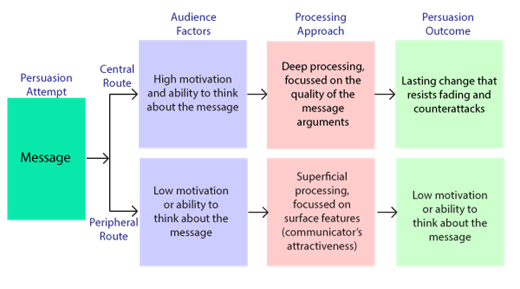
The Elaboration Likelihood Model (ELM) states there are two routes through which information is processed that can lead to a change in attitudes. They are central route and peripheral route. The central route is actively processed and the individual evaluates information in a rational manner. A person is more likely to pay attention to a message and give further thought of the information received from the sender. The peripheral route is where the receiver doesn’t actively process information, but instead relies on the style of message, credibility of source, and his/her own mood. A person gives minimal effort or elaboration to the information received by the sender EvansV2020Week4MassCommunication. See chart and video below.

Elaboration Likelihood Model Businesstopia2020ElaborationLikelihoodModel

Elaboration Likelihood Model video (1:49 mins) BrittM2013TheElaborationLikelihoodModelExplainedYouTube

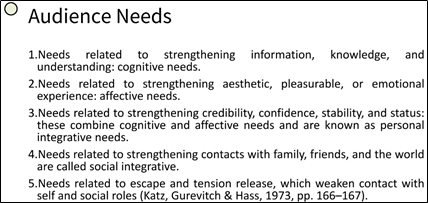
Now, let’s rewind back to the beginning of the post. I mentioned there’s an interdependency relationship between the media and audience. The ELM illustrates a one-way flow of persuasion effect of how an individual consumes messaging, but why do we consume messaging from the media especially if we are critical of its influence? Let’s look at five reasons we consume media according to the uses and gratification theory. See figure below.

EvansV2020Week4MassCommunication

We consume media to search for information such as checking a weather app before booking a vacation trip. We also use the media for pleasure or emotional needs such as watching your favorite TV show or listening to a song. Another need is for strengthening credibility or confidence through watching YouTube videos to help enhance your skills in learning a second language. The fourth need is to strengthen contacts with family and friends by watching a movie together. Lastly, we consume media to escape and release tension. Some people like listen to music while relaxing after a long day.

This is great information of why we consume media messaging. However, we must also take into account that perception works differently in different individuals based on biological differences, cultural differences, different socializing environments, different education levels, and different religious backgrounds Rosenberry&Vickers2017

The connection between ELM and audience needs for consuming media supports my position of an interdependent relationship. One cannot survive without the other. Does this mean we should be less critical of media consumption? The jury is still out on this one!

As a future media practitioner, the lesson I would take away from the elaboration likelihood model is the importance of crafting messages to appeal to the audience needs. A great deal of effort from a creative standpoint should derive from applying the techniques and skills of persuasive appeals in order to gain and maintain the audience’s attention.

Are you Fact-Checking? Be sure to do your homework, yourself!

If you are much like me, I tend to do most of my newsgathering from a variety of sources such as television, radio, and social media. I must admit that I favor social media over the other communication channels because major news outlets frequently publish stories online, outside of their normal time slots in television and radio broadcasting. To go a step further, not only do I incorporate the opinions of major news journalists, I tend to lean more in favor of gathering news from non-journalists as they too have access to breaking news and not operating under the agenda of the status quo. They are what we call ‘social media influencers’ and ‘opinion leaders.’

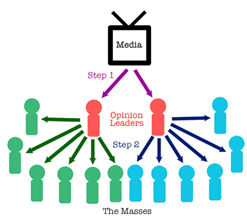
These individuals have gained acceptance and credibility with their viewers and take on the role as the gatekeeper between the media and audience as seen in the Two-Step Theory figure below. The media pays some individuals to help push their agenda. Then, there are bloggers or vloggers who take a non-partisan stance by giving their personal opinions and critically analyzing the media’s viewpoints, hoping to convince their viewers to accept them as their viable news source.

BlogsonMediaTheoryImplementationofTheTwo-StepTheory2020Bing.com

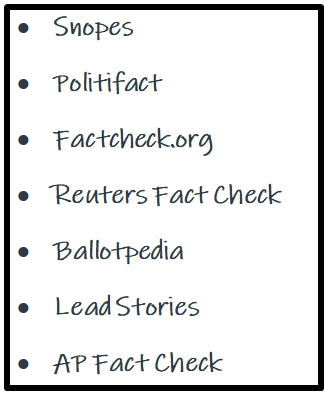
Before accepting a non-journalist as a legitimate source, there’s a period of observation and fact checking done on my end in order to deem them trustworthy. If you feel obligated to fact-check major news outlets, you should feel equally the same about checking sources from non-journalists. You want to ensure that you have a well-balanced view of information received by a variety of sources that you can validate and accept as truth. Media Bias/Fact Check, a search engine site, allows you the ability to verify information to determine its authenticity. Below is a list several fact-checking sites they suggest to use for verifying news sources.

Mediabiasfactcheck.com2020

Now that we are in an environment where the public is beginning to question the legitimacy of news media reporting, it’s important to keep an open-mind of including sources from those who are non-journalists. However, I ask that you err on the side of caution because non-journalists are also opinion leaders or people with an influential voice who could be advocates for the news media. To sum it up, fact-check any source who has the ability to sway public opinion and shape ideologies that personally affect your values and beliefs. I would consider myself more of a follower at this time because it takes a lot of time, effort, and energy to report stories and fact check them before publishing. Maybe in the near future my role will change as an opinion leader, but one who independently reports facts and not part of mass media. Until then, I will continue to rely on my short list of resources and fact-check if I desire to learn more about a topic. Check out this video (2:34 minutes) below for a quick overview of the two-step theory.

Abbit2014Two-StepTheory

A Dose of Media Influence served with a Shot of Illusion!

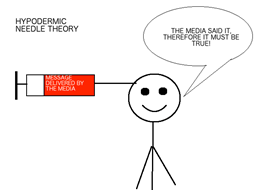
In examining the hypodermic needle theory, referred to as a hypodermic-syringe model or magic bullet theory, I take a neutral stance. The hypodermic needle theory suggests an intended message sent by the media is directly and wholly accepted by the receiver Hypodermic.Needle.Model. As much as I want to admit there have been changes over the past decade in questioning the validity of media reporting and its effects on the public, I must also admit there is still a large amount of influence the media has on public perception.

Nightengale.J.2020.Hypodermic.Needle.Theory

In today’s social and political environment, we witness many examples of the public responding to media reporting, especially right now during an election year. These responses include protests, reaction to COVID-19, political campaigns centered on personal attacks, organizations responding to social issues, etc. The media plays a major role in these reactions whether it is from television or radio broadcasting, social media, and movies and documentaries addressing social matters. The media’s influence is so instrumental in shaping perceptions and cultures that it has ignited wars and caused catastrophic events – view video below (3:59 mins).

Lopez.D.2015.Hypodermic.Neele.Theory

When analyzing various types of media influence, we should look beyond news reporting to other genres such as movies and games, as these media types also shape our cultures and perceptions about reality, particularly with children. There are scholars who believe mass communication no longer hold powerful effects over public perception as it did almost decades ago. They believe it is a combination of various forces at play. “Media effects are the result of a combination of forces, and the evolution of the theories, even at this early stage, shows how media scholars adapted to an understanding of the power of the message” Rosenberry & Vicker. 2017. We cannot deny there are various forces at play such as personal beliefs, values, and culture that shape a person’s perception of worldly views, yet, what’s equally true is that the media is a powerful influential force.

The question is, am I as vulnerable – and as likely to be affected – as the theory says, or resistant to media influence? In some ways, yes, I am vulnerable and affected as the theory says, particularly to topics and social matters that suit my personal interests and those that do not, I resist, but don’t we all?