For many decades, the belief or at least the perception is that mass media has a powerful influence on viewers to the extent that it is responsible for a person’s actions, behaviors, and self-identity. Many individuals would probably agree there is some truth to this perception. However, what is not openly discussed is the viewer’s dependency on the media and their desire to consume content for various personal reasons. This is where we explore the Elaboration Likelihood Model.
The Elaboration Likelihood Model (ELM) states there are two routes through which information is processed that can lead to a change in attitudes. They are central route and peripheral route. The central route is actively processed and the individual evaluates information in a rational manner. A person is more likely to pay attention to a message and give further thought of the information received from the sender. The peripheral route is where the receiver doesn’t actively process information, but instead relies on the style of message, credibility of source, and his/her own mood. A person gives minimal effort or elaboration to the information received by the sender EvansV2020Week4MassCommunication. See chart and video below.
Elaboration Likelihood Model Businesstopia2020ElaborationLikelihoodModel
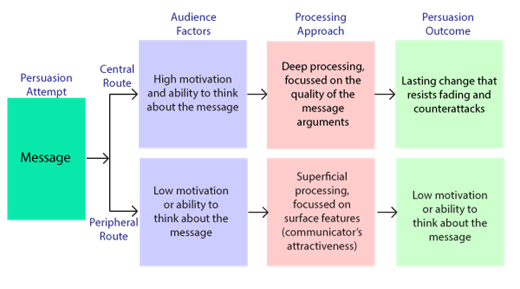
Elaboration Likelihood Model video (1:49 mins) BrittM2013TheElaborationLikelihoodModelExplainedYouTube
Now, let’s rewind back to the beginning of the post. I mentioned there’s an interdependency relationship between the media and audience. The ELM illustrates a one-way flow of persuasion effect of how an individual consumes messaging, but why do we consume messaging from the media especially if we are critical of its influence? Let’s look at five reasons we consume media according to the uses and gratification theory. See figure below.
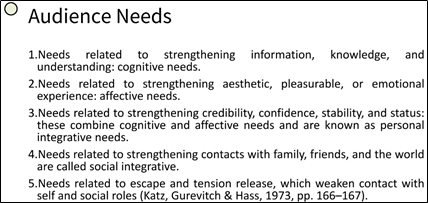
EvansV2020Week4MassCommunication
We consume media to search for information such as checking a weather app before booking a vacation trip. We also use the media for pleasure or emotional needs such as watching your favorite TV show or listening to a song. Another need is for strengthening credibility or confidence through watching YouTube videos to help enhance your skills in learning a second language. The fourth need is to strengthen contacts with family and friends by watching a movie together. Lastly, we consume media to escape and release tension. Some people like listen to music while relaxing after a long day.
This is great information of why we consume media messaging. However, we must also take into account that perception works differently in different individuals based on biological differences, cultural differences, different socializing environments, different education levels, and different religious backgrounds Rosenberry&Vickers2017.
The connection between ELM and audience needs for consuming media supports my position of an interdependent relationship. One cannot survive without the other. Does this mean we should be less critical of media consumption? The jury is still out on this one!
As a future media practitioner, the lesson I would take away from the elaboration likelihood model is the importance of crafting messages to appeal to the audience needs. A great deal of effort from a creative standpoint should derive from applying the techniques and skills of persuasive appeals in order to gain and maintain the audience’s attention.
 Mass Communications Theory - Education