Marshall McLuhan, a Canadian media scholar, theorized that forms of communication as it pertains to media technologies affect patterns of human thinking and human beings’ ways of relating to the world around them. In other words, McLuhan believed the communication channel that we use to communicate, the medium (e.g. TV, radio, phones, Internet, etc.), is more important than the message itself. Imagine face timing me, but I cannot understand what you’re saying. According to McLuhan, the fact that we were able to connect through face time is important than the message you’re trying to convey to me. Check out this short clip on McLuhan’s theory, the medium is the message.
BBCRadio42015TheMediumistheMessage
McLuhan’s focus was on how technological advancements united people together on a global level. He called it a ‘global village.’ He wanted us to understand the magnitude of how we evolved over time with technology. Come to think of it, he is correct. It’s truly amazing to see how we started from hieroglyphics to advanced technology. I will not discredit him for that. However, we cannot reduce the importance of the message itself as second in line. According to McLuhan, a culture in which this is the dominant form of communicating is going to be relational and communal Rosenberry&Vicker2017McLuhan’sTechnologicalDeterminism. For additional detail on McLuhan’s theory as it relates to advance technology, see figure below.
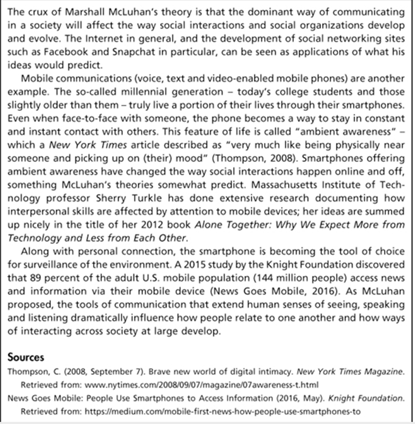
Rosenberry&Vicker2017WhatwouldMcLuhansayaboutFacebookandSmartphones
There were several strong points as well as weak points in McLuhan’s theory. His strong points are technology has developed into a global village in how we are able to connect with others around the world. It has affected the way social interactions and social organizations evolved. Another strong point he made is that technology has made it possible to where we are able to complete tasks in an efficient and effective way (using tools rather than physical energy, computer with software/hardware that can perform editing capabilities vs a typewriter, connect with a person virtually without leaving your home, etc.). Lastly, he believed that communication in the electronic era uses multiple senses as oppose to print style, which is linear. An example is someone watching television can hear the telephone ring and continue watching the show even as they take the call to talk, whereas, with the linear-print paradigm, a person trying to read a book and newspaper at the same time will not work. They would have to be read sequentially (Rosenberry & Vickers, 2017).
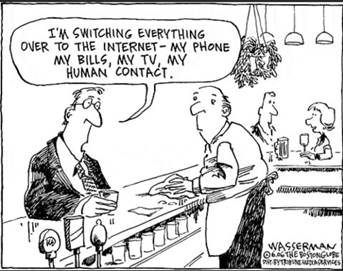
One of his weak points is believing forms of communication are more important than the message itself. I understand his rationale was to explain the effects of technology in how it’s able to connect people across the world. However, he limits this concept by understanding that no matter what form of technology a person uses, if the message is not clear, the device or form of communication is useless. Another weak point is undermining the power and value of face-to-face communication, which is just as effective today, if not more, as it was from the beginning of time. We have transitioned to a world of technological advancement replacing face-to-face communication with devices, which there’s a lot of misinterpretation, misunderstanding, and confusion. Technology has also replaced a personal, intimate form of communication. Families are selecting to have their meals in separate rooms while entertaining themselves with their electronic devices. Organizations are replacing onsite group meetings that can create great team dynamics where individuals feel comfortable expressing their ideas and opinions without countless distractions from equipment failure or attempting to multitask, not willing to give their undivided attention to the group.
Lastly, McLuhan believed it didn’t matter what an individual watched on television or who controlled the content, what matters is that an individual was watching television and not reading a magazine. His focus on technology failed to look beyond and see that something or someone (e.g. media) had the power to change social structure other than technology itself. I find McLuhan’s ideas useful in terms of how society has evolved through technology making it possible to communicate and accomplish tasks at a faster rate. We have progressed in those terms. However, I also find his ideas misleading, particularly on believing the ‘message’ is not more important than the form of communication.
 Mass Communications Theory - Education
