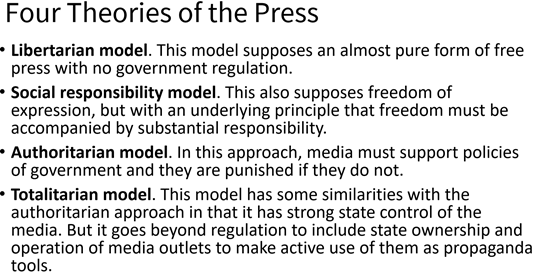
This week’s discussion focuses on international communication in how different nations have different political structures and policies as it pertains to media regulation. I selected to watch a broadcast from BBC Nightly News and ABC Nightly News to compare the differences between the two media outlets in terms of which topics covered, differences in local news, formatting, style, and delivery. Although the U.S. and European media systems are closely similar, differences are present. “European media systems operate more as social institutions while U.S. models are focused on media independence and a marketplace approach” RosenberryVickers2017TheoriesofInternationalCommunication. The Seminal Four Theories Model (e.g. Four Theories of the Press), explains the relationship of media, society, and politics around the world. Let’s see if we can identify which model BBC Nightly News and ABC Nightly News fall under.
EvansV2020Fourtheoriesofthepress
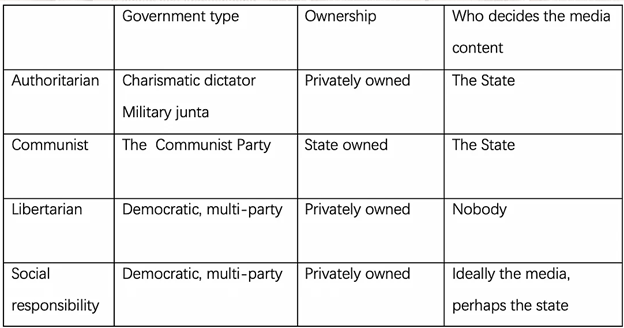
ABC Nightly News would apply to the libertarian model. The U.S. law protects the form of free press with no government relationship. BBC Nightly News would fall under the social responsibility model. “BBC, RTE and CBC are wholly or partially funded by their national governments and answerable to them. That means they have both financial incentives and government regulations and policies encouraging them to create programming “in the public interest” EvansV2020Fourtheoriesofthepress. Below is a chart with more information on the four models. It’s segmented by government type, ownership, and who decides the media content.
Wix.com2018Piece&HarmonyAnalysisofSingaporeandMalaysiaSystems
Now, let’s discuss the broadcasting differences that I witnessed between the two media outlets. The airing date for both broadcasting was on Nov. 3rd, the U.S. presidential election date. There’s no surprise the U.S. presidential race was at the top of the list, particularly for ABC Nightly News versus BBC Nightly News. BBC Nightly News published a shorter segment on the U.S. presidential race and topics such as the possibility of a cold war between China and the U.S., coronavirus lockdown in the U.K. and a terrorist attack in Vienna Austria. There were several presenters covering different topics in different background settings. Some journalists delivered their presentation standing with the stories displayed on screens and others sat with the same background setup.
ABC Nightly News spent most their airtime monitoring election results with journalists stationed across the country capturing news coverage of the race. There was one main journalist tuning into reporters in the field vs BBC journalists assigning a main journalist for almost each topic. ABC News spent the duration of time on the race, which included counting mail-in ballots in battleground states, gatherings of social movements, short interview clips of political analysts giving their take on the elections results, etc. The remainder time spent was on the terrorist attack in Vienna Austria and Hurricane forecast in Central America.
Although there were slight differences in the format, style, and delivery of information from the two news outlets, it was evident they shared similarities in terms of the media systems and political power within society. According to the Marxist political economy theories, the dependency theory states that transnational corporations with support of their home governments (especially the United States and European powers) set the agenda for world economic development. In conclusion, these two global powerhouses share similar political ideologies and government structures with the exception that European media is funded by their government. They leverage this relationship to continue remaining in elite status and push their western ideologies to less developed countries.
 Mass Communications Theory - Education