I’ve noticed over the past several years, particularly after the introduction of the coined term ‘fake news,’ there’s been more discussion around the motives behind why news media outlets report stories in a bias manner with a set agenda in mind. If you do research on the network owners and their journalists, you will most likely find a connection between the pundit’s personal views and their political affiliation. When the media has an agenda to accomplish, which is to convince the public to believe a story, we can only imagine the inaccuracy and irrelevancy of information communicated to the public, but then we must also admit there are stories that carry facts.
With so much distortion at play, the question is how do we decipher between fact and fiction? AllSides, a media research firm, employs people from different sides of the political spectrum to collect and view media stories and report findings to the public in order to maintain a democratic society with balanced news, diverse perspectives, and real conversation. Check out their video (1:31 minutes) https://youtu.be/xTfYdIzxhiI.
There are a few articles published online by the Pew Research Center that I will use as examples of media agenda setting, but first let’s define a few terms in the area of media reporting as it relates to communication theories. Framing is a process of selective control over the individual’s perception of media, public, or private communication, in particular the meanings attributed to words or phrases Framing (communication theory). In other words, media reporting can control an individual’s perception about almost anything or anyone by the use of words and phrases. Another term used in media reporting is agenda setting, which describes the way media attempts to influence viewers, and establish a hierarchy of news prevalence Agenda Setting (communication theory). As noted above, the media has a motive for influencing viewers and the intent is to establish dominance within society.
Below is an image of agenda setting theory in its simplest form and definitions of several communication theories that tie into agenda setting and framing.
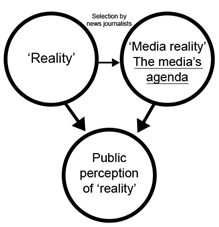
Alonso.AgendaSetting.Theory.Image
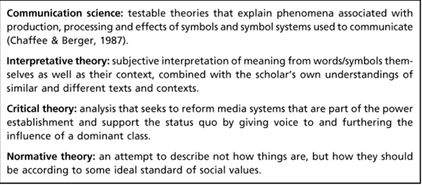
Rosenberry & Vickers. 2017. Communications Theories
Several media topics published by Pew Research Center focuses on social media companies’ interference of an individual’s right to free speech. The articles are titled, ‘Most Americans think Social Media Sites Censor Political Viewpoints,’ ‘Most Americans say social media companies have too much power, influence in politics,’ and ‘Fast facts about Americans’ views of social media companies as Trump-Twitter dispute grows.’ Here’s the link to the articles Pew Research Center. 2020.
Based on the context of the articles, there’s a presence of agenda setting and framing. The authors’ motive is to convince readers that social media companies have too much power and control over an individual’s freedom of expression. The practice of critical theory is present in the articles because the authors seek to reform social media companies’ involvement in censoring users as they view them as members of the status quo class. We also find normative theory present as the authors pointed out how things should be which in this case is an individual’s right to express themselves without censorship. I guess we can say both parties (social media companies and authors) are guilty of framing and agenda setting!
Reference
Alonso, A. (2014). Agenda Setting Theory Model. Retrieved from
Pew Research Center. (2020). Internet & Technology. Retrieved from
https://www.pewresearch.org/internet/
Rosenberry, J. & Vicker, L. (2017). Applied Mass Communication Theory. A Guide for Media Practitioners. Retrieved from
https://bookshelf.vitalsource.com/#/books/9781134974283/cfi/6/2!/4/2/2@0:2.69
Wikipedia. (2020). Agenda Setting Theory definition. Retrieved from
https://en.wikipedia.org/wiki/Agenda-setting_theory
Wikipedia. (2020). Framing Theory definition. Retrieved from
 Mass Communications Theory - Education
